 |
|
 |
Get our FREE |
|
|
|
|
Get our FREE |
    |







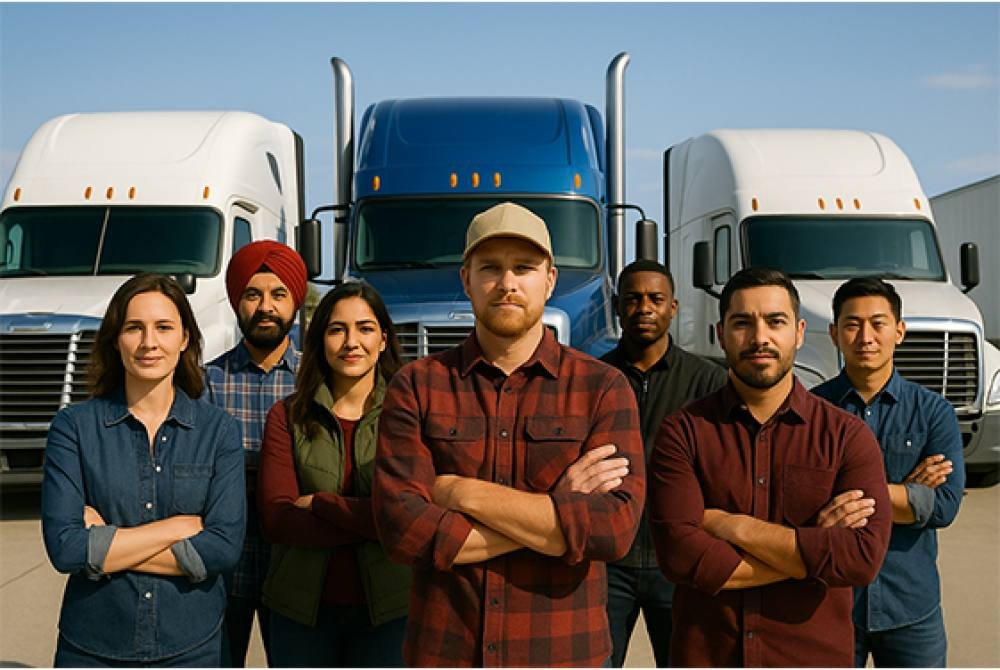
The American highway is no longer the exclusive territory of the traditional “road cowboys.” In recent years, the trucking industry has welcomed drivers from all over the world — Hispanic, Asian, African, European, and Middle Easte
. Each brings not only hard work, but also distinct customs, work habits, and cultural values. This growing diversity is quietly transforming the way people drive, operate, and coexist on the road.
The numbers tell the story. According to the American Transportation Research Institute (ATRI), the proportion of white drivers dropped from 77% in 2014 to 63% in 2023, while Hispanics now represent about 23%, African Americans 18%, and Asians around 4%. Drivers from the Middle East make up nearly 2%, and about 18% of all current drivers were bo
outside the United States, according to the Bureau of Labor Statistics and the National Association of Truck Stop Operators (NATSO). This shift is not only a response to the ongoing driver shortage — it also enriches the industry with new perspectives. From communication styles to customer relations and attitudes toward night driving, every culture adds its own unique strengths.
Each group brings distinct traits: Latino drivers often value camaraderie and teamwork; Asian drivers are known for discipline and punctuality; African drivers tend to emphasize community support; Europeans are typically methodical and less tolerant of improvisation; and Middle Easte
drivers often show strong adherence to DOT safety and compliance rules. In multicultural fleets, this diversity calls for greater attention to cross-cultural communication and policies that consider language, dietary, and rest differences.
The impact of this diversity is twofold. On one hand, it represents a competitive advantage — diverse teams are more empathetic, creative, and adaptable to a multicultural market. This richness of perspectives strengthens company identity, improves customer relations, and helps retain talent in an industry with high tu
over.
On the other hand, it also brings operational and social challenges. When not managed with sensitivity, diversity can lead to misunderstandings: what one driver sees as respect, another might interpret as indifference. Language or cultural differences can create confusion or exclusion if companies don’t promote genuine inclusion.
In states like Califo
ia, where Latino, Asian, European, and Middle Easte
communities converge, this reality is especially visible. The goal isn’t to make everyone the same, but to build a culture that values and leverages differences. In a country built by roads and immigrants, every driver carries more than just freight — they carry their story, their language, and their unique way of understanding the road ahead.

In trucking, tight delivery schedules can put drivers under a lot of pressure. The real problem starts when a dispatcher...
read more...
From August 23 through 29, 2026, Brake Safety Week will take place, with inspections focused on commercial vehicle braki...
read more...
Construction zones demand a driver’s full attention, especially when operating a loaded truck. Narrow lanes, sudde...
read more...
Ah, summer! It is one of the busiest times of the year for truckers, and with long hours on the road and plenty of fatig...
read more...